The Garden of Forking Paths
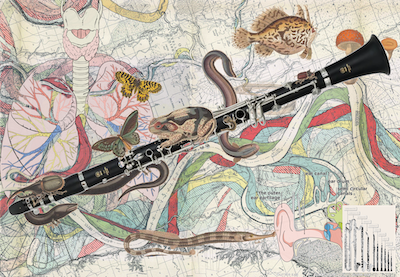
Composing for contingency and material indeterminacy in clarinets (2019–current).
About
The Garden of Forking Paths began as an 18-month AHRC Leadership Fellowship at the University of Leeds (August 2019 – January 2021): practice research in composing for one and two clarinets. Instead of starting from the notes I want the clarinet to play, the project starts from the instrument itself: trying fingerings, often unusual ones, and listening to which pitches, multiphonics and timbres come out of them with different embouchures, mouth shapes and breath.
The central question is what happens if the clarinet is given more agency than is typical, so that (with support of the player's listening and technique) the clarinet can make its 'own' sounds: the harmony and resonances that lie outside the 12 pitches of the piano, and the noisy, unstable, and multiphonic sounds that traditional teaching tends to ignore. Rather than a a paradigm of complete control of the instrument it becomes a paradigm of support, setting up a system in which the player follows the instrument's preferences. That raises practical questions: what can be fixed before a performance, how to notate pitches and rhythms that emerge rather than being chosen, and how a piece can respond to the instrument's own resonances. The title comes from Jorge Luis Borges' 1941 short story of the same title, but the image I keep returning to is a river where every time it floods its course is rerouted and made newly concrete, as is also int he clarinet in performance as sound moving between stable and unstable states, settling differently every time.
The work was done laboratory-style, with specialist performers and an acoustician, and documented online as it went: scores and recordings, video tutorials, a blog, a symposium and a listening workshop, as well as a 'shadow project' at the Royal Northern College of Music. Since the fellowship ended the approach has carried on into new pieces, including works for other instruments.
Project website YouTube playlist Writing: 'The Material Clarinet'
People
- Scott McLaughlin: project lead and composer
- Alex De Little: postdoctoral researcher
- Heather Roche: clarinet, principal collaborator
- Jonathan Sage: guest clarinet and basset clarinet
- Prof. David Sharp (The Open University): acoustics
- Larry Goves and Sarah Watts, with students of the Royal Northern College of Music: RNCM shadow project
- Also: Carlos Cordeiro (Strata), Laurel Saunders and Grace White (Venting Game Duet)
Pieces
- Clarinet solos, duets and studies: Strata, Fringing, Maquette for Natura Naturans, Venting Game Duet, and the loading and venting studies. For Strata there is also the Strata player, which combines recordings by Carlos Cordeiro at random.
- Natura Naturans (2021), solo clarinet and prepared string orchestra, for Heather Roche, BBC Scottish Symphony Orchestra and Tectonics Glasgow
- Natura Naturans II (2022), solo clarinet and six strings, for Apartment House
- an instrument is polarised inside itself (2022), basset clarinet (or B♭ clarinet), for Jonathan Sage
- Repetition weaves difference weaves repetition (and so on) (2025), saxophone, for Lucy Havelock
- The field of the future is reticulated through and by the present (2025), bass clarinet and double bass, for Heather Roche and Dominic Lash
- Daisy Chains: an open, participatory piece that chains clarinet fingerings together as multiphonics; anyone can add to it
Scores on the project website
Scores of the studies and solos, free to download (they open in Dropbox).
- Loading Study no. 1 (v.2)
- Chalumeau Venting Study no. 1 (v.1)
- Register Venting Study no. 1 (v.1)
- Register Venting with Embouchure Shifts (v.1)
- Register venting contingent tones "wax & wane" (v.1, text score)
- Maquette for Natura Naturans
- Strata (clarinet with a punctured barrel)
- Fringing
- an instrument is polarised inside itself: basset clarinet, B♭ clarinet version
- Venting Game Duet (v.1)
Learning resources
Videos made with Heather Roche for clarinettists and composers who want to work this way.
Tutorials
- Tutorial 1: Resonance and registers, with an extra on underblown altissimo fingerings
- Tutorial 2: Loading and venting, with an extra: chalumeau venting catalogue
- Workshop on half-hole notation (Heather Roche and Scott McLaughlin)
- Heather Roche: advice for learning the chalumeau venting study
Examples
- Exploring multiphonics #1
- Deconstructing multiphonics #1
- Deconstructing multiphonics #2
- Register venting, Jonathan Sage
- 'Stripped clarinet': first tests with Jonathan Sage
Tools
- Multiphonics.app. Heather Roche's gamechanging online database of multiphonic fingerings: searchable and filter-able, with recordings, and editable lists, and much more.
- Fingering & Register Tablature generator. My interactive web-tool for clarinet fingering tab and register stave/tab.
- Bret Pimentel's fingering-image generator.
Talks
- Royal Musical Association conference, 2020: overview talk and workshop
- Public lecture: 'Rethinking the clarinet as an animal' (13 February 2025)
The project website also has a reading and listening list (instrument books, music and theory) and a blog written as the research went along.
Performances and events
-
The field of the future is reticulated through and by the present. Heather Roche (bass clarinet), Dominic Lash (double bass). Rainy Days Festival, Luxembourg.
-
Repetition weaves difference weaves repetition (and so on). Lucy Havelock (saxophone), Goldsmiths, London.
-
Public lecture: 'Rethinking the clarinet as an animal'. Recording.
-
Seminar on the project, and a concert in which Heather Roche played Fringing. Sonic Lab, SARC, Queen's University Belfast. Details.
-
Natura Naturans II. Heather Roche and Apartment House, Wigmore Hall, London.
-
Strata, Carlos Cordeiro, with a lecture. Hochschule für Musik Freiburg.
-
an instrument is polarised inside itself. Jonathan Sage (basset clarinet), Late Music Festival, York.
-
Fringing. Heather Roche, Huddersfield Contemporary Music Festival, St Paul's Hall. Video.
-
Strata. Carlos Cordeiro, Clothworkers Centenary Concert Hall, University of Leeds. Concert video (from 51:03).
-
Natura Naturans. Heather Roche, BBC Scottish Symphony Orchestra, Ilan Volkov, Tectonics Glasgow. Video.
-
Vibrant Practices symposium (online), with a keynote by Alice Eldridge, panels, installations, a workshop, and a concert by Heather Roche: Loading Study no. 1, Chalumeau Venting Study no. 1, Register Venting with Embouchure Shifts and Maquette for Natura Naturans, alongside new clarinet pieces by Ed Cooper, Anna Höstman, José del Avellanal Carreño and Kevin CK Lo. Programme, concert video.
-
Venting Game Duet. Laurel Saunders and Grace White, RNCM shadow project. Video.
Videos
- Trailer: Staging the Garden of Forking Paths
- Fringing, Heather Roche
- Chalumeau Venting Study no. 1, Heather Roche
- Strata, Carlos Cordeiro
- Strata: all takes superimposed
- Strata: all endings superimposed
- Natura Naturans: extract
- Repetition weaves difference weaves repetition (and so on), Lucy Havelock
RNCM shadow project
Alongside the fellowship, staff and students at the Royal Northern College of Music took the research in their own directions, with thanks to Larry Goves and Sarah Watts. It produced three breaths (after Ben) by José Del Avellanal (four versions of the score, each with a different notation), Slushball Earth by Tywi Roberts (Johanna Leung), Output VI by Zakiya Leeming (Yanke Dai, Laurel Saunders and Grace White), my Venting Game Duet, and a composite Daisy Chains performance. It ended with a concert on YouTube. Scores and videos on the project website.
Writings
- McLaughlin, Scott (2022), 'The Material Clarinet', in Rethinking the Musical Instrument, ed. Mine Doğantan-Dack (Cambridge Scholars). The new approach to writing for clarinet that came out of the project. Review by Roger Heaton, Tempo (January 2023).
- McLaughlin, Scott (2021), 'The Impossibility of Material Foundations', in Sound Work: Composition as Critical Technical Practice, ed. Jonathan Impett (Leuven University Press). Includes discussion of the clarinet pieces.
- McLaughlin, Scott (2022), 'On Material Indeterminacy', Contemporary Music Review (open access). Mostly written in 2019, just before the project; it sets out the ideas the project started from.
Related
- There are neither wholes nor parts (2010–12): multiphonic pieces for single reeds, an early version of these ideas
- Prepared Instruments: the same approach applied to strings and piano